Showing posts with label climate change. Show all posts

Monday, June 6, 2016

The Cost of Getting Rid of Fossil Fuels

The climate change narrative goes something like this:

The burning of fossil fuels such as coal and oil emits large quantities of CO2. That CO2 traps heat from the sun that would otherwise be radiated into space. The trapped heat is causing higher temperatures on average as well as more intense droughts and storms. The changing climate is causing extinctions, diseases, and deaths. Glaciers and polar ice caps are melting and will flood our coastal cities unless we do something. We have to stop burning fossil fuels in order to avoid flooded cities, huge storms, terrible droughts, and other terrifying consequences. The economic costs of changing our energy infrastructure will be huge, but we have to save our coastal cities and ecosystems.

This climate change narrative is wrong.

Melting icecaps and droughts are predicted by the most recent Intergovernmental Panel on Climate Change Report. This report is based on sophisticated computer models which use more than a century of weather data. It was extremely thoroughly peer-reviewed and vetted. I'm not arguing with that.

We should stop burning fossil fuels because it will help the economy.

A revenue neutral carbon tax would both help stop global warming and improve the economy. A carbon tax is a tax on CO2 emissions. Those are the emissions that cause global warming. A revenue neutral tax is a new tax which is offset by a decrease in other taxes. In the case of a revenue neutral carbon tax, the government would refund an equal share of the tax revenue to each American.

Coal miners and S.U.V. mechanics would lose their jobs, but solar technicians would gain jobs. So where does that leave us economically? According to Keynesian fiscal multiplier theory (review your macroeconomics 102 here), right back where we started. The carbon tax would depress economic output (lost jobs in the coal industry). Americans would spend their carbon tax refund checks disproportionately on solar and wind power (more jobs in those industries). Because the amount of the tax is equals to the amount of the refund, the effect on economic output (GDP) is neutral.

The carbon tax and tax refund puts money into the pockets of Americans who produce less CO2 than average (those who consume fewer carbon intensive goods and services) and takes money from those who produce more CO2. On average, the wealthy produce more CO2 than the poor (when is the last time you saw a poor man with a private jet). The poor spend more of their income than the wealthy who save more. The monetary redistribution of the carbon tax and refund would stimulate the economy, increasing GDP and with it employment.

But we can do better. There will need to be improved energy infrastructure necessary to support the changes in energy production. Someone will have to build a new energy grid. Because the grid will support the new power sources that will sustain everyone, it makes sense that the government should pay for it. And low and behold, the government has a great source of revenue in the form of the carbon tax. It could take a portion of that tax and use it to build an improved grid. The increased spending would stimulate the economy even more than refunding the entire carbon tax. (Some percentage of the refunded tax is saved. That saved portion does not stimulate the economy.)

Have you seen the flaw in my argument yet? On its own, a carbon tax would make American industry less competitive. A factory in India would be able get its energy from the cheapest source possible (assuming India does not also implement a carbon tax) whereas a factory in Ohio would have to pay a carbon tax or buy more expensive clean energy. Companies would move production overseas. The carbon tax would be exporting both jobs AND pollution. Bad news. But it's easily fixed. The U.S. could simply slap onerous tariffs on goods from countries whose carbon emissions policy was not at least as progressive. As the largest consumer market in the world, every country will fall in line and adopt a carbon tax or something similar.

So there you have it. Of course, climate change is a great reason to implement a carbon tax. The scientific consensus is clear. Humans are causing the climate to warm and that warming will have dire consequences. We will have to address climate change in order to preserve our way of life. But if you don't believe that, fine. No problem. We should tax carbon emissions anyway. It will help the economy. The climate skeptic's economic argument falls flat on its face. Getting rid of fossil fuels won't cost us money. It will be a huge boost to the economy.

Wednesday, May 18, 2016

Climate Change? An Easy Solution!

Okay a Relatively Easy Solution

Okay an Incredibly Hard Solution That's Better Than All the Alternatives

Recently I posted some simple math showing why we need to address climate change. But how, you ask? Big thorny problem, right? Well, yes and no. The solution looks like this:

STEP 1: Move to a carbon neutral economy

STEP 2: Remove greenhouse gases from the atmosphere

STEP 3: (Maybe) employ other cooling mechanisms

As usual if you want to skip to the to TL;DR Summary, I won't begrudge you your sloth.

A Carbon Neutral Energy Economy

Step 1 is the easy part. Humans emit lots of greenhouse gases, primarily as a result of food and energy production and transportation. We need to move to carbon neutral ways to heat our homes, commute to work, and grow our food. All of human activity should produce little to no greenhouse gases. We will likely have to use solar power, nuclear power, electric cars, non-traditional fertilizers, and many other technologies. In fact, we don't know what technologies will advance fastest or if there will be new technologies that we can't imagine. The government could subsidize these technologies, but it might choose the wrong technologies or the wrong companies.

A Carbon Market

We should let the market choose the technologies that will save the planet. Friedrich Hayek showed that markets (usually) allocate resouces and set prices more efficiently than central authorities, so we'll let the a market save the planet.

Hippies may claim we can save the planet by sitting in unheated mud huts and adopting a diet of grubs and grass, but they can fuck off. No one will do that. The politics of asceticism are a dead-end. The market has been an amazing driver of technological advancement, but those advances aren't guaranteed to be green. Government can fix that by providing the right incentive: a carbon tax.

Tax carbon dioxide emissions and net carbon emissions will decrease. People will find less carbon intensive ways to do whatever they need to do: light their homes, power their cars, grow their food. It really is that simple. Of course you'll need to tax equivalent activities as well (emitting a ton of methane is equivalent to emitting 25 tons of CO2). There's a downside of course, climate deniers say. A new tax would severely stunt our economy and a lot of people would lose their jobs, right? Not if the carbon is offset with tax credits. At a macroscopic level, an increase in tax receipts decreases economic output, but we won't increase tax receipts. Instead, we will refund every American an equal share of the carbon tax collected. As an added bonus, this will be welcome relief for the poor who (for the most part) are engaging in less carbon intensive activities. Carbon intensive economic industries will suffer. However, the tax used to discourage the activity will be refunded, so low carbon industries will make up the difference. Simultaneously, firms that pollute less will prosper. Firms that pollute more will change their ways or go out of business.

Much of the world already puts a price on carbon emissions either through the carbon tax I just described or through more complex cap and trade system (which works more like the stock market of pollution). I prefer a carbon tax, but a properly implemented cap and trade schema can also work. Skip to the end for more discussion.

What would the tax rate be? It should start low and increase. Not too slowly, but not too quickly. This will give industry time to develop innovative energy solutions. Politicians should NOT be given control over the rate. That would be a recipe for disaster. If Congress ever grows big enough balls to implement a plan like this, they should protect it from future politicians by creating an independent council of economists and climatologists.

Atoning For Our Past Sins

Temperature increases lag CO2 increases, so stopping CO2 emissions isn't enough to avoid the worst effects of climate change. We must also remove CO2 from the air. There are a number of possibilities for doing this. We could bury caron underground in the form of biochar. We could capture it from the air and convert it to methanol. We could fertilize the oceans and let algae do the storage for us. Here's the scary part. We need to reduce atmospheric carbon dioxide by 592 trillion kg (592,000,000,000 kg) to get back to pre-industrial levels. Current carbon capture and storage costs are around $40 per metric ton (1,000 kg). This would give us a cost of $23.7 trillion to return to pre-industrial levels of CO2. However, that price is likely low for three reasons. First, current carbon capture technology is designed for power plant. Essentially, it's a fitting on a smokestack. Filtering carbon dioxide from the air would be much harder. Second, current carbon storage technology injects CO2 gas deep underground. There's no way we could inject trillions of pounds of gas underground. We'll likely have to pull the carbon out of the CO2 and use it for something or bury it. Third, as we suck CO2 out of the atmosphere, the ocean will start to give off CO2 gas. This is a good thing. There's too much of it there and it's causing ocean acidification, but we don't know how much is there and we'll have to capture and store a lot of that, too. We can only hope that technology will make it cheaper to deal with our CO2 problem, but we can assume that the cost will be on the order of worldwide GDPs.

Unfortunately, bringing down the CO2 levels might not be enough! Temperature changes lag CO2 changes. We will likely have to employ additional cooling methods. We could seed clouds or stimulate volcanic eruptions to reflect more sunlight. Or we could do something even more creative. These are drastic actions not to be undertaken lightly, but we probably won't have much choice. It is going to be expensive, but I'm not even going to venture a guess how expensive.

Of course, we will have transitioned to an economy based on clean, renewable energy, so these global scale projects will benefit from extremely cheap energy, but they will still be expensive. The sooner we stop spewing CO2, the less CO2 we will have to remove and the less the greenhouse effect will heat the Earth. Thus, the sooner we move to a carbon neutral economy (we can do this for free), the cheaper it will be to remove the CO2 from the atmosphere and cool the planet (if need be). Let's save ourselves some pain and adopt a carbon tax now.

TL;DR Summary

  1. Transitioning to a carbon neutral economy can be done for free
  2. Sucking the CO2 out of the air and cooling the Earth will be VERY expensive
  3. The sooner we transition to a carbon neutral economy, the cheaper it will be to fix the CO2 balance and fix the climate

Cap and Trade Vs. Carbon Tax

In a carbon cap and trade scheme, a governmental body allocates or sells a limited number of permits to emit certain quantities of CO2 (or equivalent polluting activity) per year. Polluters are required to hold permits in amount equal to their emissions. Polluters that want to increase their emissions must buy permits from others willing to sell them.

There are several problems with such schemes. First, during recessions, demand for goods and services decreases. This decreases the price of permits and polluters can pollute cheaply. This increases the competitiveness (such as coal fired power plants) of polluters against non-polluters (such as wind-power farms). Secondly, it is easier to set up a carbon tax. Any given activity (emitting methane, cutting down a tree of a given size, tilling an acre of silage) can be taxed at a rate equivalent to emission of a given amount of CO2. It would be much more complicated to set up a comprehensive exchange. It would require farmers, brewers, power plants and many, many other businesses predict their expected carbon output and trade permits with each other. A carbon tax also has the advantage that it allows polluters to pollute above the level that they predict. Put another way, in a cap and trade scheme, there are a fixed number of permits, so the power plant that exceeds its demand late in the year is screwed. There may be no permits left. In a carbon tax system, that power plant simply pays the tax. Of course, the government directly control the amount of pollution under cap and trade, but I feel that it is better to provide economic flexibility (you wouldn't want your mom's pacemaker to shut off because all the permits were used). The tax can always be raised next year if industry exceeds a given level of pollution.

Quantity of CO2 to Remove

The Earth's atmosphere is 5.15×10¹⁸ kg of gas. Presently 0.04% of the atmosphere is CO2. In 1850, the atmosphere was 0.0285% CO2. Thus we need to remove 5.9225×10¹⁵≈592 trillion kg CO2 to return to pre-industrial levels.

Wednesday, May 11, 2016

Climate Change Since 1850

Today I came across a most excellent visualization of our changing climate. Ed Hawkins, professor of meteorology at the University of Reading, put it together. The animation below shows the change in temperature above pre-industrial (1850) levels. Every frame is one year.

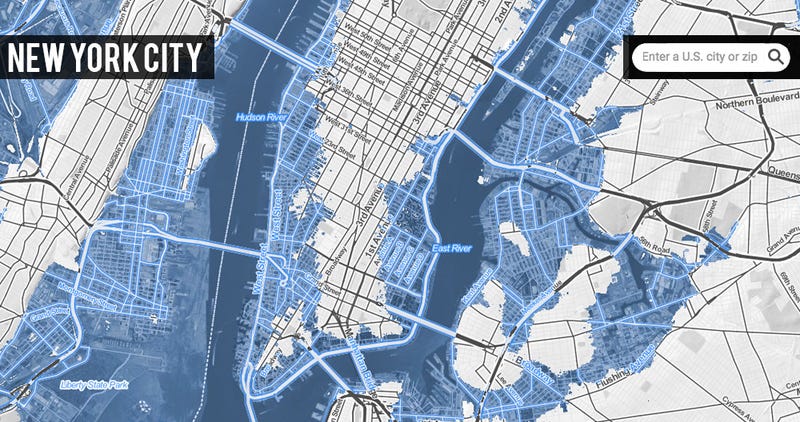
Scary looking, no? Notice how much faster the temperature is increasing as time goes on? We can expect even more increases. We are remarkably close to 1.5 degrees above pre-industrial levels. At 2 degrees, large parts of Manhattan will flood:

Tuesday, May 10, 2016

Climate Change: The Math

Many people deny humans are causing climate change, but few of them are climate scientists. 97% of climate scientists agree that anthropogenic climate change is really happening. There's tons of evidence.

I'm inclined to agree with the 97% of climate scientists who agree humans are causing global warming, but what if they're wrong? Nothing is certain in life but death. The climate change debate is not as settled as the Nickelback debate. They suck and no one is arguing the point—not even them:

Should we address climate change?

I won't refute all of climate deniers' arguments here. In fact, I don't have to. We can decide whether or not to do something about climate change without being 100% sure that it's happening. Sounds crazy, huh? It isn't. People make decisions with imperfect information about the future all the time. Parents save for toddlers' college education knowing full well that the rugrats might swallow a lego and kick the bucket. Frat boys buy roofies even though their jealous girlfriends might cut off their dicks at any moment.

It Is or It Isn't

Climate change is real or it isn't. The most ardent denier (skeptic) or proponent can agree on that. It sounds simple, but it's an important point. We can't CHOOSE whether or not climate change is real. Hopefully, the scientific consensus is wrong and climate change isn't real. Our temperature measurements are off. But it isn't our choice. It's physics. Humans are causing the Earth to heat up or they aren't.

What's in it for us?

Should we do something about climate change? Let's consider the four scenarios:

  1. Climate change is real and we address it
  2. Climate change is real and we ignore it
  3. Climate change is not real and we address it
  4. Climate change is not real and we ignore it

What would happen in each scenario?

Remember that we can't CHOOSE whether or not climate change is real, but we CAN choose whether to do something about it. Here the doing something about it means spending money to transform our energy infrastructure from a fossil fuels based infrastructure to a renewable energy based infrastructure. We get to choose the top row (do something about climate change) or the bottom row (do nothing).

We can use the model to avoid the worst outcome. That outcome happens if climate change is real and we do nothing. We don't need to put numeric values to the outcomes to know that.

Let's go ahead and put dollar values on the scenarios anyway. For penny pinchers, this is about to get grim. The model below uses some very conservative assumptions about the impacts of climate change. The numbers represent the economic costs to the U.S. this century. They don't take into account any human costs such as injury, loss of life, or extinction of species.

We can also calculate the average outcome (or expected value) of each action. Using gambling terminology, we consider the expected "payout" of various possible "wagers". We calculate the expected value of an action by multiplying the probability of a scenario occurring by the payout (how nice is the outcome). We then do that for each action. So how likely is it that climate change is real? I think 97% certain is a reasonable number, but we can examine multiple scenarios.

Note that it doesn't much matter how certain we are that climate change is real. Even if we are only 30% sure that climate change is real, it is still worthwhile to address the problem. The impacts are so incredibly bad that they far outweigh any costs we take to address the problem. Using this model, we have to be 90% certain that climate change ISN'T real for it to be worthwhile to NOT address it. Even then, we might want to hedge our bets in order to avoid

If climate change is real and we choose to do nothing, we are fucked. F-U-C-T. FUCT! Our way of life will cease to exist. Refugees will flee flooded and scorching hot areas. Tropical diseases will make their way into temperate areas. Wildfires will rage. It will basically be the apocalypse.

If climate change is not real and we choose to address it anyway, we will unnecessarily spend a few trillion dollars on some cool new technology.

TL;DR Summary

  1. Climate change is real and humans are causing it
  2. The worst impacts of climate change are apocalyptic
  3. Even if we aren't certain climate change is real, it is still in our economic interest to address it
  4. We can't risk doing nothing

The Denier's Rebuttal

Many deniers acknowledge that the Earth is getting warmer. It's pretty hard to deny given the temperature data. The 3% of climate scientists that refuse to acknowledge humans are causing climate change. Many of those still acknowledge the temperature data. The Earth is still heating up, they believe, but we can't be confident that humans are causing it yet.

This scenario is a red herring advanced by climate change deniers. Let's consider it anyway.

If we assume global warming is occurring but is not caused by humans, my analysis still holds! Any NATURAL warming that is disrupting human life and the broader ecology, we still need to address the issue!

So what would we do? Well, it isn't clear. If it isn't humans causing climate change, we don't know what is. In order to address, it we need to figure out what is going on and fast! In this case, we need to increase climate research funding. Of course, we need to do that anyway.

Model Assumptions

The estimated economic impact of climate change is estimated conservatively at $3.8 trillion per year by the end of this century if we do nothing. That number includes financial losses from flooded coastlines, higher energy costs, bigger hurricanes, and higher water and agriculture costs. It does NOT include the deaths from storms or heat. It does NOT include any of the costs of the wars that will ravage the earth. But let's roll with $3.8 trillion per year. Now the total cost this century would be $160 trillion.

This model assumes that the costs to convert the American economy to clean, renewable energy would be 1/2 2016 GDP or $8.5 trillion. That number is rather high. In fact, I believe that we can convert the economy for free or close to it. Crucially, if climate change is real, we will have to convert the economy to clean, renewable energy, anyway. We can do it now or later, so that cost has been added to $160 trillion cost of climate change for a total do-nothing-and-climate-change-is-real of $168.5 trillion.

This model assumes that we will only be able to avert half the cost of climate change if we start tomorrow. This is the most uncertain part of this model.